

Introduction
For years, a UAE invoice could be a PDF sent by email. That is changing. Under the UAE Electronic Invoicing System, business invoices will be issued as structured data, exchanged through accredited service providers and reported to the Federal Tax Authority (FTA) close to real time.
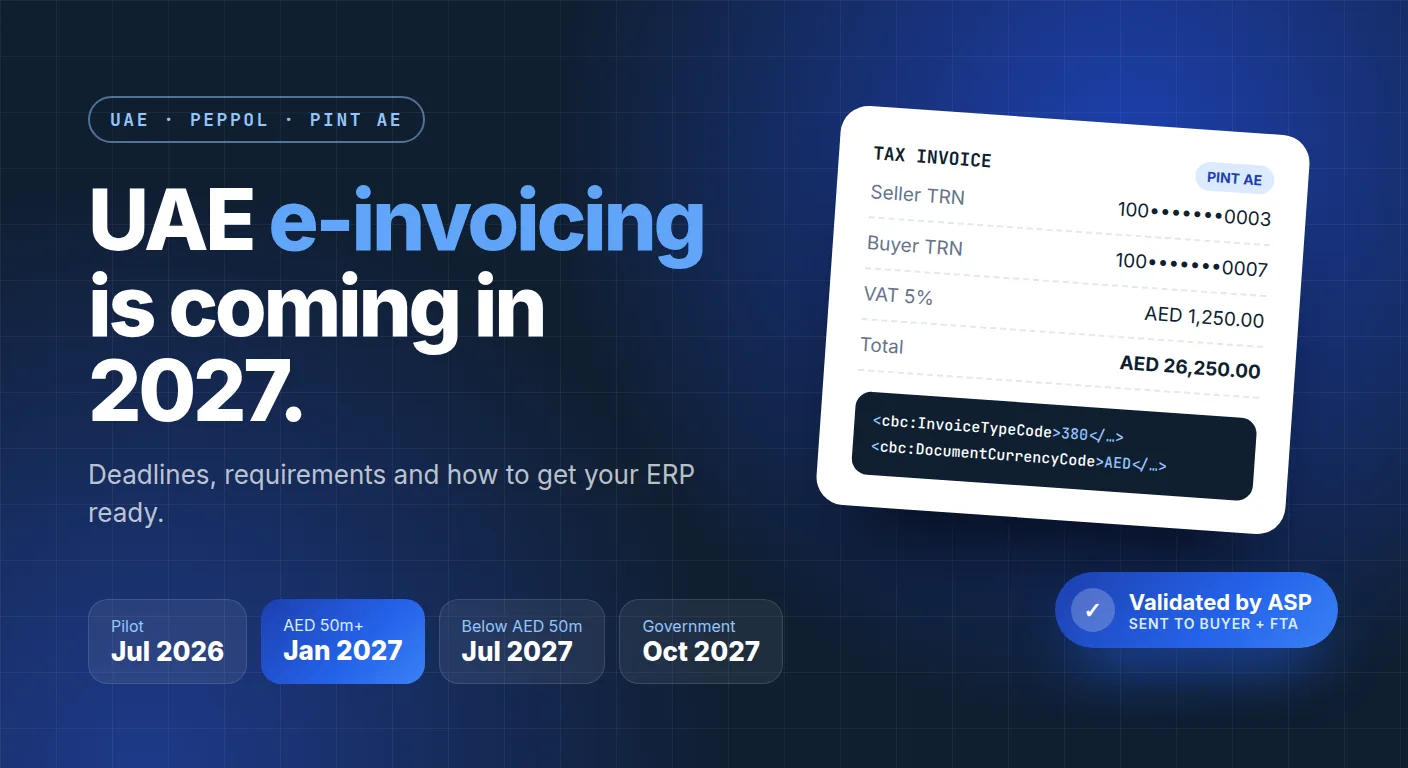
The first mandatory phase starts on 1 January 2027 for businesses with annual revenue of AED 50 million or more, and the rest follow through 2027. If your invoices come out of an ERP, a spreadsheet or a mix of both, now is the time to plan the change, because the work sits in your systems and master data, not just in your invoice template.
This guide explains what the mandate is, which deadline applies to you, how the system works and what your ERP has to do to be ready.
What UAE e-invoicing is
E-invoicing is not the same as emailing a PDF. A PDF is a picture of an invoice that a person has to read. An e-invoice is a structured file, in XML, that the buyer's system can read automatically and the tax authority can receive as data.
The UAE framework was set out in Ministerial Decisions No. 243 and No. 244 of 2025, which define the electronic invoicing system and the implementation timeline. Invoices follow the PINT AE format, the UAE version of the international Peppol invoice standard, so they can move between different software platforms without custom integrations.
In practice this means three things for a business: invoices must be generated in the required data format, they must be sent and received through an accredited service provider (ASP), and key invoice data is shared with the FTA as part of the exchange.
Deadlines by business size
The rollout is phased. Each group has two dates: one to appoint an accredited service provider, and one to go live with e-invoicing.
- Pilot and voluntary adoption: from 1 July 2026, selected businesses take part in a pilot and others can adopt e-invoicing voluntarily.
- Revenue of AED 50 million or more: appoint an ASP by 30 October 2026 (extended from 31 July 2026), go live on 1 January 2027.
- Revenue below AED 50 million: appoint an ASP by 31 March 2027, go live on 1 July 2027.
- Government entities: appoint an ASP by 31 March 2027, go live on 1 October 2027.
Deadlines have already been adjusted once, so confirm the dates that apply to you against the latest Ministry of Finance and FTA announcements. Whatever your phase, the systems work usually takes longer than the paperwork. Starting three to six months before your go-live date is a sensible minimum.
How the system works
The UAE uses a five-corner model built on the Peppol network. It sounds complex, but the flow is simple once you see who does what:
- Corner 1, the seller: your ERP creates the invoice as structured data.
- Corner 2, the seller's ASP: validates the invoice against the UAE rules and sends it across the network.
- Corner 3, the buyer's ASP: receives the invoice and delivers it to the buyer.
- Corner 4, the buyer: their system imports the invoice automatically, with no retyping.
- Corner 5, the FTA: receives the required invoice data from the ASPs for tax reporting.
The important point for your business is corner 1. The ASP can only send what your ERP gives it. If customer tax numbers are missing, products are not classified correctly or VAT is calculated inconsistently, invoices will be rejected before they ever reach your customer.
Which invoices are covered
The mandate focuses on business-to-business (B2B) and business-to-government (B2G) transactions for VAT-registered businesses, including tax invoices and tax credit notes. Business-to-consumer (B2C) sales, such as retail till receipts, are expected to follow later and are not part of the first phases.
Some transaction types and special cases have their own rules or exclusions, and these have been updated through later decisions. If you run a VAT group, deal in exempt or zero-rated supplies, or invoice across borders, check how the current rules treat those transactions before you design your process.
What your ERP must do
Whatever ERP you use, it needs to handle these jobs before go-live:
- Produce invoices and credit notes in the PINT AE structured format, with every mandatory field filled.
- Hold clean master data: customer legal names, Tax Registration Numbers (TRN), addresses and product tax categories.
- Calculate VAT consistently at line and document level, so totals match what the ASP validates.
- Connect to your chosen ASP to send invoices and receive status updates such as accepted or rejected.
- Receive supplier e-invoices from your ASP and match them to purchase orders and bills.
- Keep a clear audit trail of every invoice, its status and any corrections.
If you already run Odoo, much of this sits in the accounting and UAE localisation setup: tax configuration, partner data and invoice layouts. The remaining work is mapping fields to the PINT AE format, connecting to your ASP and testing real invoice scenarios end to end. On older Odoo versions, an upgrade is often the cleanest route, because e-invoicing support improves with each release.
A 6-step readiness plan
This is the sequence we follow with UAE clients preparing for e-invoicing:
- 1. Confirm your phase: check your revenue band and write down your ASP and go-live dates.
- 2. Audit your invoicing: list every system that issues or receives invoices, including branches, ecommerce and manual spreadsheets.
- 3. Clean master data: fix missing TRNs, inconsistent customer names and product tax categories. This is usually the biggest single task.
- 4. Choose an ASP: pick an accredited provider that connects well with your ERP, and agree on testing support.
- 5. Configure and integrate: map invoice fields, set up the ASP connection and handle statuses and rejections inside the ERP.
- 6. Test, train and go live: run real scenarios such as credit notes, discounts and foreign currency, train your finance team, then switch over with support in place.
Businesses below AED 50 million have more time, but should not wait. ASPs and implementation partners will be busiest in the months before 1 July 2027.
Common mistakes to avoid
- Treating it as a template change. The format is data, not design. A nicer PDF does not make you compliant.
- Choosing an ASP before checking your ERP. The provider has to fit your system, not the other way round.
- Leaving master data until the end. Missing TRNs and wrong tax categories cause most rejections.
- Forgetting incoming invoices. You will also receive e-invoices from suppliers, and your purchasing process needs to handle them.
- Testing only simple invoices. Credit notes, partial deliveries, discounts and multi-currency invoices are where problems appear.
What to do next
UAE e-invoicing is a systems project with a fixed deadline. The businesses that find it easy are the ones that start with their data and their ERP, not with the last-minute switch.
Truodo helps UAE businesses get their Odoo ready for e-invoicing: reviewing tax and master data, configuring invoices for PINT AE, connecting to an accredited ASP and testing before go-live. If you are not on Odoo yet and your current system cannot support the mandate, we can plan a fixed-scope implementation around your deadline.
Book a free consultation and we will review your current invoicing setup and give you a clear plan, with dates, before your phase begins.